

Automated Material Handling System Market
The warehouse is no longer being automated around a fixed blueprint. Flexible robotics are changing the economics of throughput, capacity and capital and rewriting the rules of material handling.
Wilmington, DE, United States, Sept. 08, 2026 (GLOBE NEWSWIRE) -- Warehouse Automation is Becoming the New Marketplace for Supply Chain Sovereignty
Material handling has shed its identity as a back-office cost center and repositioned itself as a board-level strategic variable. What used to be a procurement decision routed through facility managers now sits in conversations about competitive durability, labor exposure, and fulfilment economics. A significant share of operators are still planning around assumptions that were defensible four years ago, and the cost of that lag is becoming visible quarter by quarter.
Capacity to design, integrate, and commission complex automation systems is finite, and the queue is lengthening. Operators treating automation as a future capital project are now bidding against operators treating it as a present-tense operating discipline. The window between those two postures is closing fast, and the firms moving early are locking in vendor relationships and system architectures that will define their cost base for a decade.
Request a Free Sample Report: https://marketmindsadvisory.com/request-sample/?report_id=39
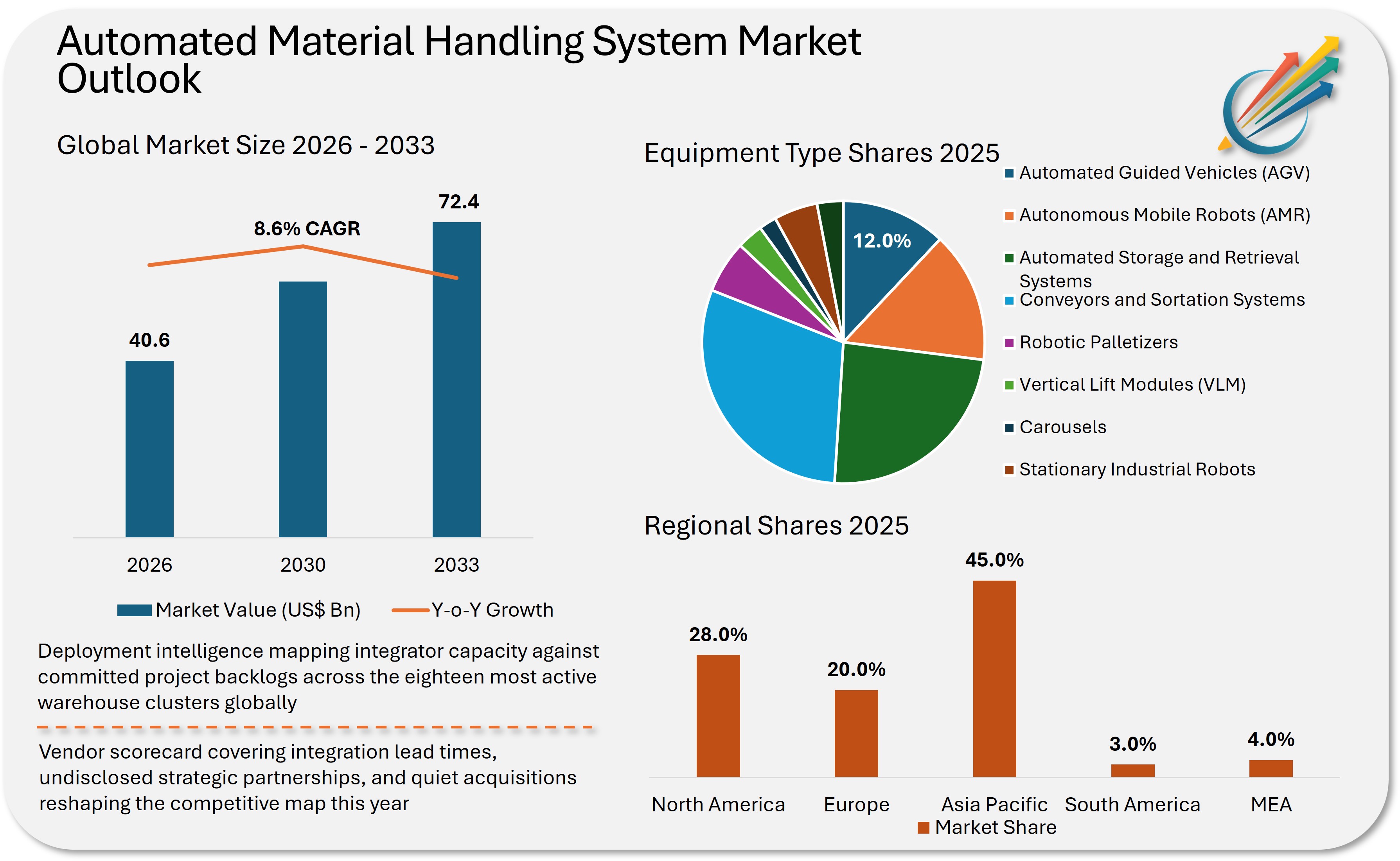
Key Takeaways from Automated Material Handling System Market
- Automated material handling system market valued at US$ 40.6 Billion in 2026, advancing toward US$ 72.4 Billion by 2033
- Sustained CAGR of 8.6 percent through the 2026 to 2033 forecast window
- Autonomous Mobile Robots are absorbing the largest share of incremental deployment budgets
- E-commerce and third-party logistics together account for the dominant demand pool
- Retrofit automation systems are outpacing greenfield builds in mature warehouse geographies
- Integration capacity, not equipment supply, is the binding constraint on deployment timelines
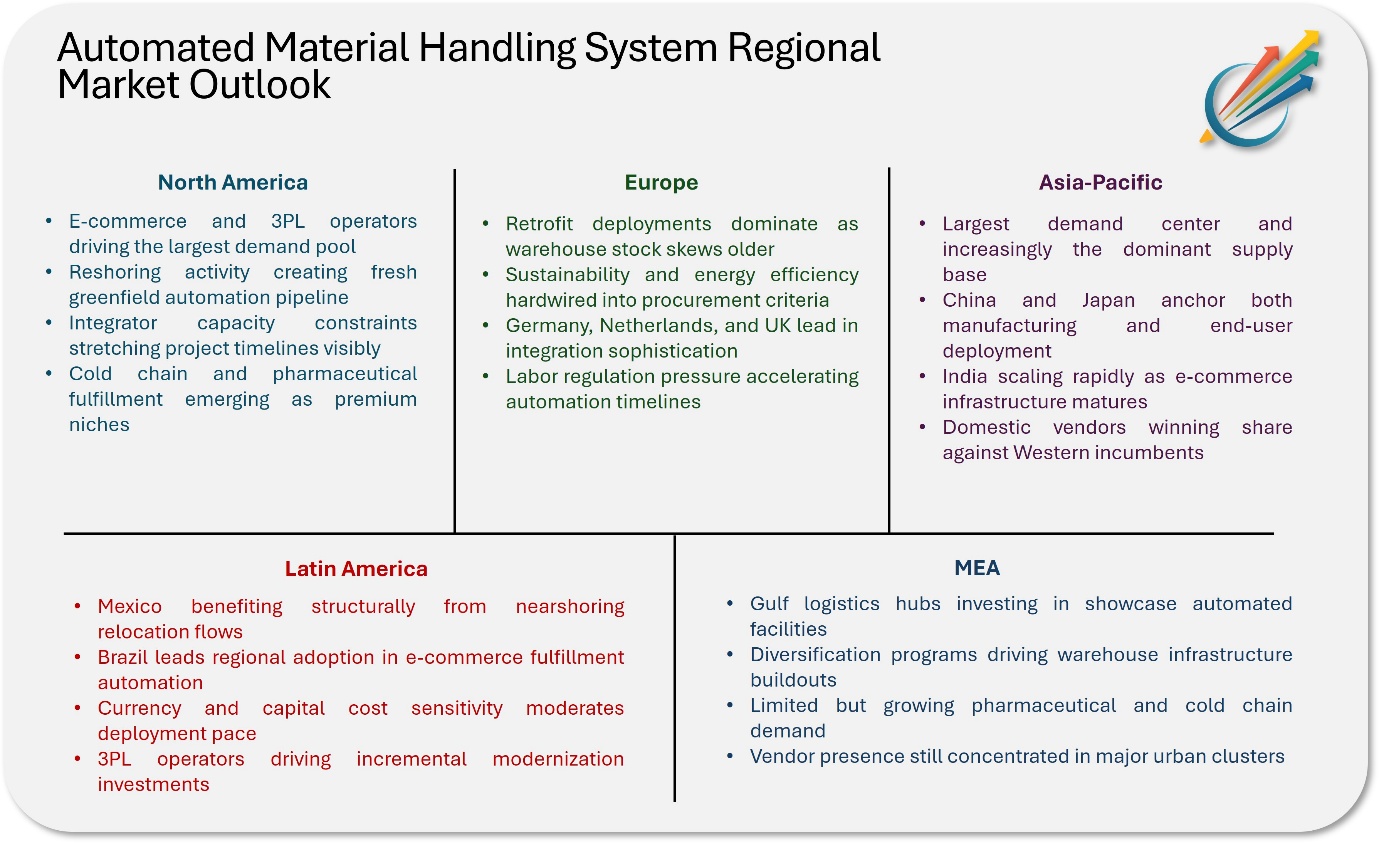
- Asia-Pacific is consolidating its position as both the largest demand center and supply base
As per Lead Analyst from Market Minds Advisory, "Material handling automation has stopped being an efficiency play and become a structural hedge against labor volatility and fulfillment cost inflation. Operators that finalize system architecture and integration partnerships within the next four to six quarters will define their per-unit economics through the end of the decade."
Strategic Window Why the Next Four Quarters Will Decide Vendor Access for Years
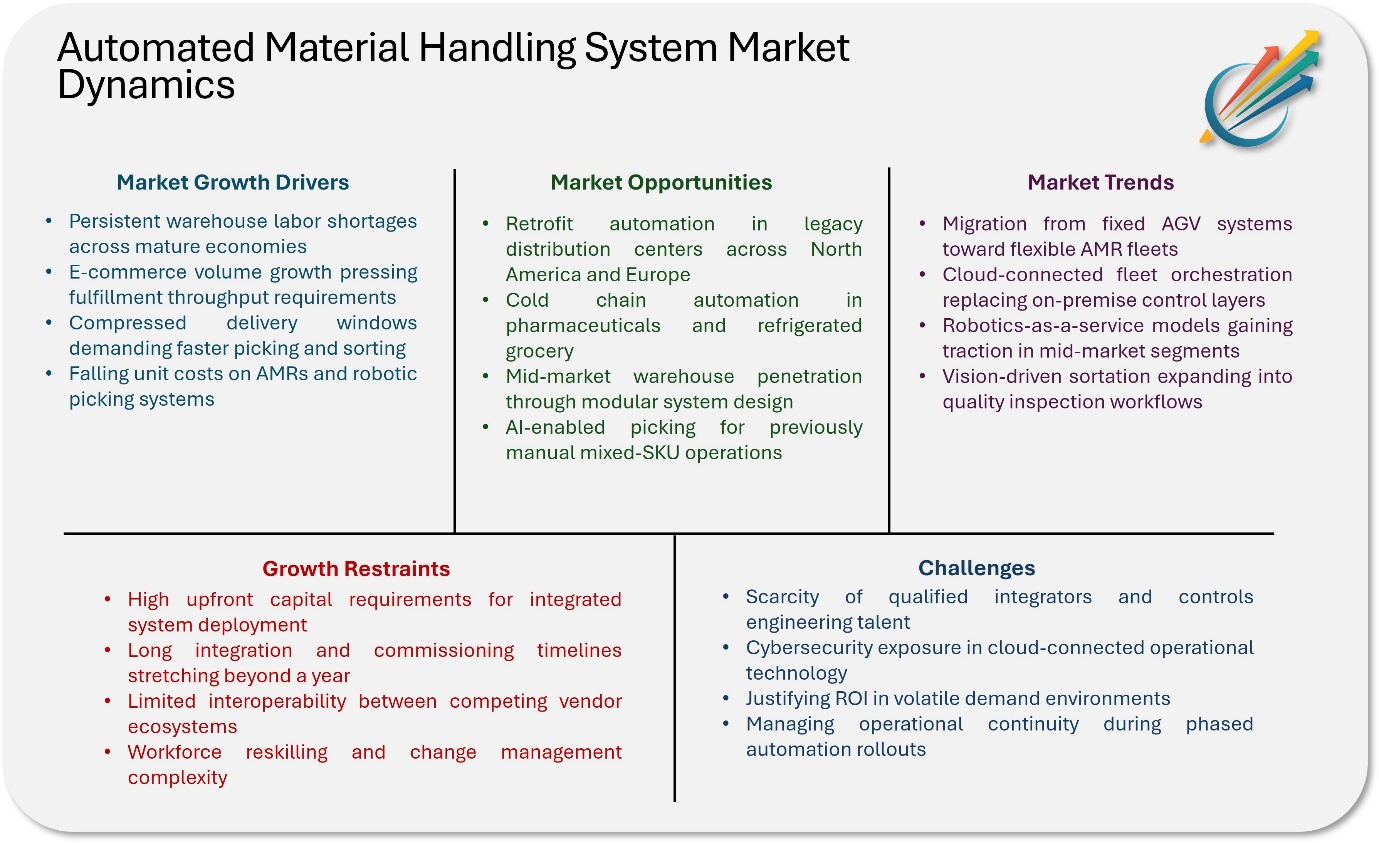
- Integrator capacity is the real bottleneck: Equipment can be manufactured. Skilled systems integrators, controls engineers, and commissioning teams cannot be scaled at the same pace, and project queues already stretch past 2027 at top vendors.
- Labor economics have crossed a threshold: Warehouse wage inflation, peak-season staffing gaps, and turnover costs have pushed payback periods on automation below the level most CFOs require for approval.
-
Architecture choices made now are sticky: WMS integration, fleet management platforms, and equipment standards established in this deployment cycle will dictate procurement decisions for the next ten years.
Software Orchestration Quietly Impacting the Hardware Margin
Hardware differentiation is narrowing. The decisive value is migrating into orchestration layers, fleet management software, and the analytics that determine throughput per square foot.
- Fleet orchestration platforms are commanding premium economics: Vendors that own the software brain coordinating heterogeneous robot fleets are capturing margin that pure equipment makers cannot defend, and the spread is widening.
- Modular architectures are displacing monolithic system design: Operators are demanding scalable building blocks they can add to incrementally, which favors vendors with strong APIs over those with proprietary closed ecosystems.
-
Vendor lock-in is being engineered in real time: Cloud-connected systems create recurring revenue streams and switching costs that reshape vendor economics, and most buyers are not negotiating these terms with adequate scrutiny.
Strategic Outlook Market Realities that Diverge from Consensus Expectations
A significant portion of announced automation projects will slip 12 to 18 months past their original commissioning dates. The constraint is integrator bandwidth, not equipment availability, and most project plans assume integration timelines that no longer hold. Realistic scheduling has become a competitive differentiator.
The AGV category will lose share to AMRs faster than most forecasts suggest. Fixed-path systems are being replaced in retrofit deployments where flexibility matters more than peak throughput. The transition is already visible in tier-one e-commerce buyer specifications.
Consolidation among integrators will reshape vendor selection within three years. Equipment OEMs will acquire integration capacity to control delivery timelines, and several mid-tier system integrators will be absorbed or partnered out of independent existence.
Structural Forces Reshaping the Automated Material Handling System Value Chain
Reshoring and supply chain regionalization
Manufacturing relocation toward North America, Mexico, Eastern Europe, and parts of Southeast Asia is generating a fresh wave of greenfield warehouse demand. These facilities are being designed with automation embedded from day one rather than retrofitted later, which structurally favors vendors with strong integrated system offerings and shifts demand patterns away from legacy distribution hubs.
Convergence of robotics and AI vision systems
Computer vision and machine learning are being fused into picking, sorting, and quality inspection workflows. The result is that previously unaddressable tasks, particularly mixed-SKU handling and unstructured item recognition, are entering the automation perimeter. Vendors with credible AI capability are pulling away from those still selling pure mechanical solutions, and the gap compounds each release cycle.
Energy and sustainability mandates
Corporate decarbonization commitments and rising energy costs are reshaping equipment selection criteria. Energy-efficient conveyors, regenerative drives, and lithium-ion fleet electrification are moving from optional features to procurement requirements at major buyers. The sustainability story is becoming a meaningful filter in vendor shortlists, particularly among European operators and global retailers.
Cold chain and pharmaceutical specialization
Temperature-controlled fulfillment and validated pharmaceutical handling represent the highest-margin pockets of the market. Specialized automation for refrigerated environments, GMP-compliant equipment, and serialization-ready conveyors are emerging as defensible niches where pricing power remains intact even as commodity segments compress.
Risk Assessment Material Headwinds That Could Moderate Deployment Pace
- Higher cost of capital is extending payback hurdle rates and slowing some large-format deployments.
- Qualified systems integrators and controls engineers are in structural short supply across most major markets.
- Cloud-connected and IoT-enabled systems widen the attack surface, with insurance and compliance implications still maturing.
- Rapid evolution in AMR and AI capability creates concern about depreciation of assets installed today.
- Semiconductor availability, tariff regimes, and component routing remain sensitive variables in equipment cost.
- Operational disruption during commissioning and workforce resistance can erode projected returns if not actively managed.
These risks are material but not directional. The structural case for accelerated automation adoption holds across every plausible scenario, even where individual projects encounter delays or scope adjustment.
Market Dynamics Shaping the Automated Material Handling System Market
Automated Material Handling System Market Segmentation
By Equipment Type
- Automated Guided Vehicles (AGV)
- Autonomous Mobile Robots (AMR)
- Automated Storage and Retrieval Systems
- Conveyors and Sortation Systems
- Robotic Palletizers
- Vertical Lift Modules (VLM)
- Carousels
- Stationary Industrial Robots
- Crane-Based Handling Systems
- Others
AMRs are absorbing the largest share of incremental investment, displacing both manual processes and earlier AGV deployments. Conveyors and sortation remain the throughput backbone in high-volume parcel and e-commerce environments. AS/RS systems continue to anchor dense storage applications, particularly where land economics favor vertical buildouts. Robotic palletizers are seeing renewed interest as end-of-line labor pressure intensifies.
By System Type
- Standalone Automated System
- Integrated Warehouse Automation System
- Modular / Scalable Automation System
- Retrofit Automation System
- Cloud-Connected System
- Others
Integrated systems dominate greenfield deployments where operators want end-to-end orchestration from receiving through outbound. Modular and retrofit configurations are gaining disproportionate share in mature geographies where existing facilities must be upgraded without disrupting operations. Cloud-connected architectures are becoming the default specification at tier-one buyers, reshaping vendor economics toward recurring revenue.
By Application
- Order Picking and Fulfillment
- Palletizing and Depalletizing
- Case Packing and Cartoning
- Sorting and Routing
- Assembly
- Buffering and Sequencing
- Goods Receiving and Putaway
- Returns Processing and Reverse Logistics
- Quality Inspection and Vision Sorting
- Others
Order picking and fulfillment commands the largest application share, driven directly by e-commerce volumes and SKU proliferation. Returns processing is emerging as a strategic priority as reverse logistics costs become a board-level concern. Vision-based quality inspection is the fastest-evolving application category, benefiting from rapid improvements in AI model performance.
By End Use Industry
- E-Commerce and Retail
- Third-Party Logistics
- Automotive & Auto Components
- Food and Beverage
- Pharmaceuticals and Healthcare
- Electronics and Semiconductor
- Consumer Goods
- Cold Chain and Refrigerated Warehousing
- Industrial & Heavy Equipment
- Others
E-commerce, retail, and 3PL operators together account for the dominant share of new deployments, reflecting the structural pressure on fulfillment economics. Pharmaceuticals and cold chain represent the highest-margin verticals where compliance and temperature integrity command premium pricing. Automotive and electronics remain stable institutional buyers, anchoring demand through industrial cycles.
Shape this report around your priorities: https://marketmindsadvisory.com/request-customization/?report_id=39
Regional Market Outlook
Investment Focus where the Highest-Value Opportunity is Concentrating
Fleet orchestration software
The most defensible economics sit in the software brain that coordinates heterogeneous robot fleets across complex workflows. Vendors owning this layer extract recurring revenue, accumulate operational data assets, and create switching costs that pure hardware competitors cannot replicate. This is where strategic acquirers are paying premium valuations.
Mid-market modular automation
The underserved gap between manual operations and tier-one integrated systems is the structurally attractive pocket. Modular, scalable configurations priced for mid-market warehouses unlock a buyer pool that has been waiting for accessible entry points, and vendors solving the price-performance equation here will compound advantages quickly.
Cold chain and pharmaceutical specialization
Temperature-controlled fulfillment and validated pharmaceutical handling resist commoditization pressure that affects general warehouse automation. Compliance complexity, capital intensity, and specialized engineering create durable margin pools. Buyers in these verticals prioritize reliability and regulatory fit over headline price.
AI-enabled picking and vision sortation
Tasks previously locked outside the automation perimeter are now addressable as vision and machine learning capability matures. Mixed-SKU picking, induction automation, and quality inspection represent the frontier where capability improvements translate directly into expanded total addressable market for vendors with credible AI depth.
What This Means for Decision-Makers
Warehouse operators and 3PLs - The procurement window is narrowing faster than most planning cycles assume. Locking integrator capacity and finalizing system architecture within the next four quarters will materially influence cost position through 2030 and beyond.
Equipment OEMs and integrators - The competitive edge is migrating into software, services, and integration depth. Pure hardware positioning is becoming a margin-compressed segment, and acquiring orchestration capability or integration scale is now a strategic imperative rather than an option.
Investors - The thesis has matured beyond early-stage robotics speculation. Fleet orchestration software, mid-market modular platforms, and specialized cold chain and pharmaceutical automation offer clearer risk-adjusted returns than commodity equipment exposure.
End-use industry buyers - Treating automation as a strategic asset rather than a procurement step is the posture that compounds advantages. The gap between buyers using automation as a fulfillment lever and those treating it as a cost line is widening visibly each quarter.
Competitive Landscape: Automated Material Handling System Market
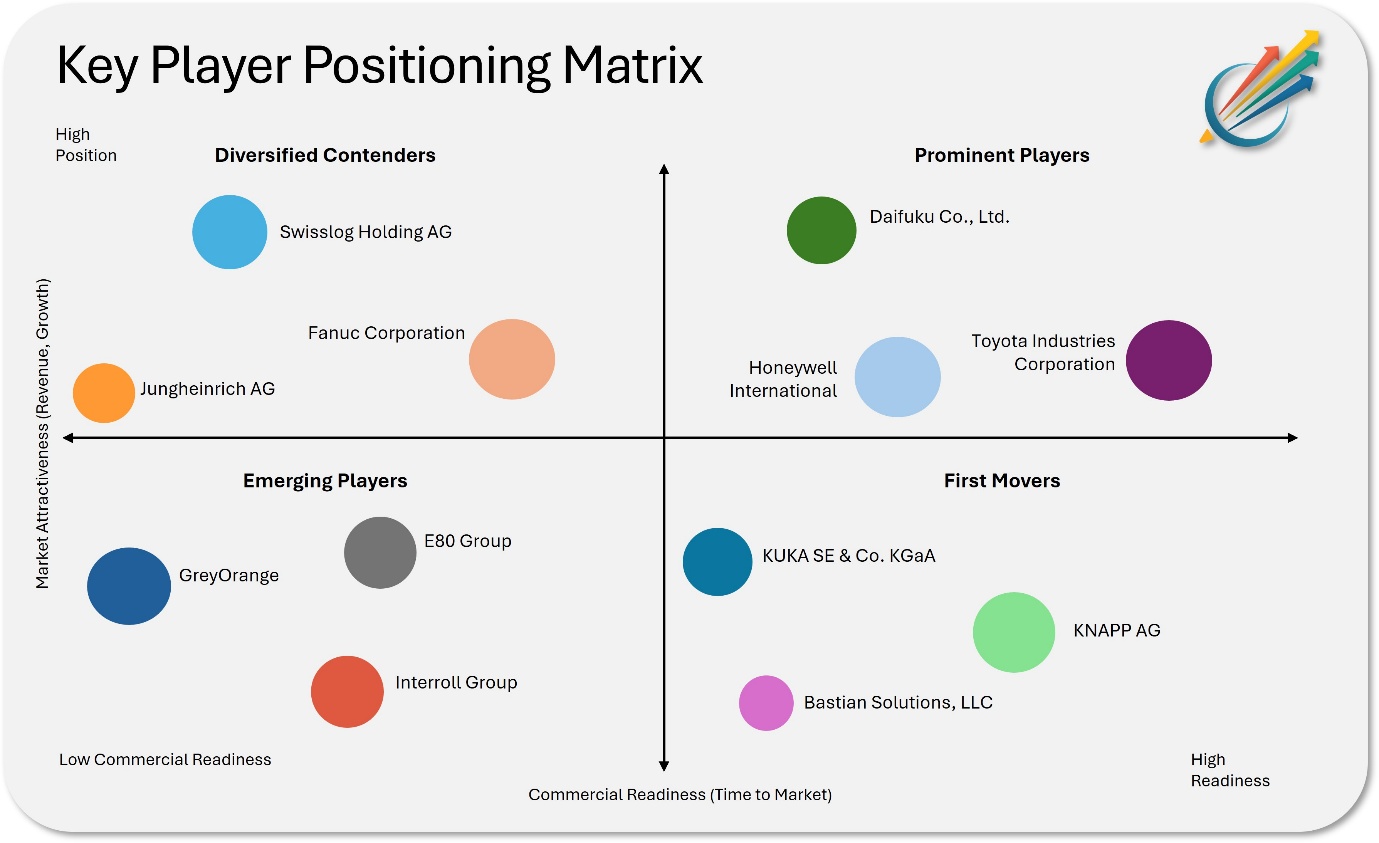
Recent Market Developments
- In February 2026, Dematic announced expansion of its software and integration capacity to address backlog in North American e-commerce deployments.
- In March 2026, Daifuku Co., Ltd. confirmed continued investment in expanding its AMR and AS/RS portfolio to meet rising demand across pharmaceutical and semiconductor end-users.
- In January 2026, GreyOrange announced extended partnerships with global 3PL operators to scale flexible fulfillment automation across multiple geographies.
- In April 2026, Vanderlande Industries B.V. outlined a broader push into airport and parcel automation, reinforcing its position in high-throughput sortation segments.
Market is segmented by Equipment Type (AGV, AMR, Automated Storage and Retrieval Systems, etc.), System Type (Standalone System, Integrated Warehouse Automation, Modular / Scalable , etc.), Application (Order Picking and Fulfillment, Palletizing and Depalletizing, Sorting and Routing, Goods Receiving, etc), and End Use Industry (E-Commerce and Retail, Third-Party Logistics, Automotive & Auto and Others)
Get Access to complete Analysis, Buy Now: https://marketmindsadvisory.com/buy-now/?report_id=39
Trending Related Reports
- Warehouse Robotics Market: The warehouse is becoming a software-defined operation. The real advantage won’t come from owning more robots, but from orchestrating them better than competitors.
- Military Robots Market: The military robotics race is shifting from machines to machine networks reshaping who wins the next generation of defense contracts, software and sustainment revenue.
- Industrial Automation Market: Industrial automation is crossing a critical threshold from automating tasks to autonomously optimizing operations. The winners will be decided by who scales first.
- Unmanned Aerial Vehicles Market: The drone industry is being disrupted from within: airframes are becoming commodities while autonomy, payloads, software and mission data emerge as the real battleground.
- Coatings and Application Technologies Robotics Market: Coating robotics is quietly changing the economics of manufacturing turning overspray, labor and inconsistent quality into measurable competitive disadvantages.
- Conveyor Systems Market: The next competitive advantage in logistics may not be robotics, it may be the conveyor intelligence quietly deciding how fast, efficiently and reliably everything moves.
- Automated Sortation System Market: The next warehouse bottleneck won't be storage, it will be flow. Discover why sortation is becoming the critical control point for scale, speed and profitability.
- Material Handling Equipment Market: The next material-handling battleground isn’t equipment, it’s the economics of moving goods. See where automation, labor and facility redesign are changing the rules.
- Industrial Robotics Market: The robotics race is no longer about who builds the best robot, it is about who can automate faster, redeploy smarter, and capture the next generation of manufacturing capacity.
- Network Automation Market: The network automation paradox: enterprises are buying automation faster than they trust it. The next competitive edge will belong to platforms that make humans irrelevant.
Why choose Market Minds Advisory
Market Minds Advisory delivers decision-grade intelligence to executives across machinery, packaging, chemicals, automotive, ICT, food and beverage, consumer goods, and healthcare. We help organizations sharpen market expansion strategies, accelerate share gains, refine brand positioning, and enable account-level growth. Our forecasting integrates primary interviews, proprietary demand models, and continuous market validation, producing the kind of clarity volatile and emerging industries require. Backed by over a decade of sector expertise, our research surfaces white space, opportunity gaps, and competitive blind spots, accounting for recent developments and geopolitical risk. We help businesses see the future of their markets.
Contact Us
Market Minds Advisory
1521 Concord Pike, Suite 301
Wilmington, DE 19803
United States
T: +91 935 631 3602
Email: sales@marketmindsadvisory.com
Website: https://marketmindsadvisory.com/


Legal Disclaimer:
EIN Presswire provides this news content "as is" without warranty of any kind. We do not accept any responsibility or liability for the accuracy, content, images, videos, licenses, completeness, legality, or reliability of the information contained in this article. If you have any complaints or copyright issues related to this article, kindly contact the author above.
